5 Fuzzy Sets on 1100 Continuous Universe
Fuzzy Logic - Introduction S. G. Sanjeevi
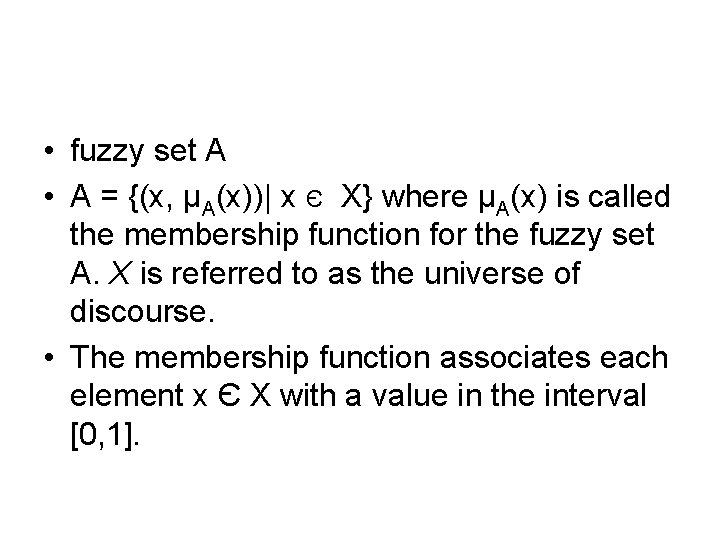
• fuzzy set A • A = {(x, µA(x))| x Є X} where µA(x) is called the membership function for the fuzzy set A. X is referred to as the universe of discourse. • The membership function associates each element x Є X with a value in the interval [0, 1].
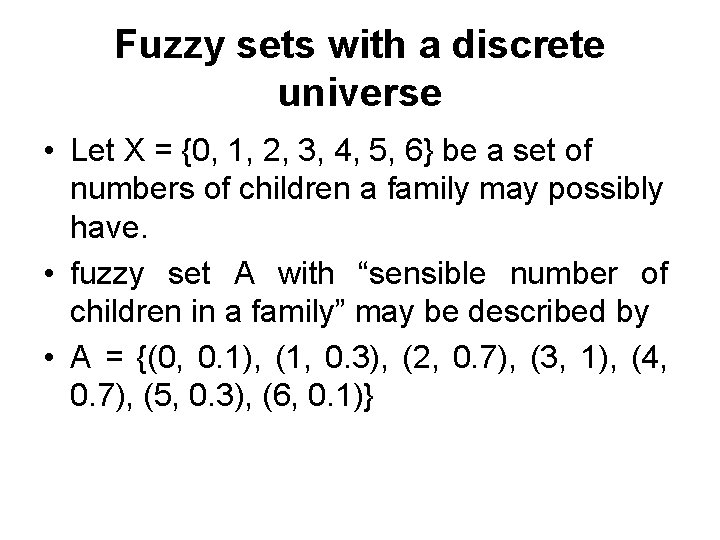
Fuzzy sets with a discrete universe • Let X = {0, 1, 2, 3, 4, 5, 6} be a set of numbers of children a family may possibly have. • fuzzy set A with "sensible number of children in a family" may be described by • A = {(0, 0. 1), (1, 0. 3), (2, 0. 7), (3, 1), (4, 0. 7), (5, 0. 3), (6, 0. 1)}
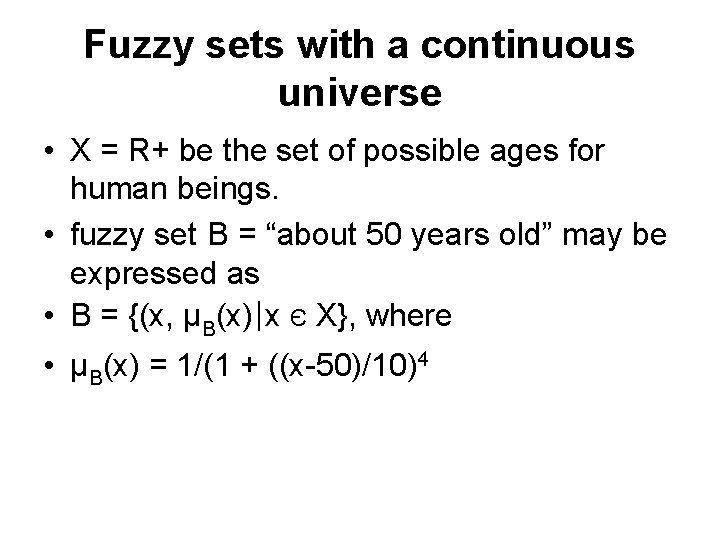
Fuzzy sets with a continuous universe • X = R+ be the set of possible ages for human beings. • fuzzy set B = "about 50 years old" may be expressed as • B = {(x, µB(x)∣x Є X}, where • µB(x) = 1/(1 + ((x-50)/10)4
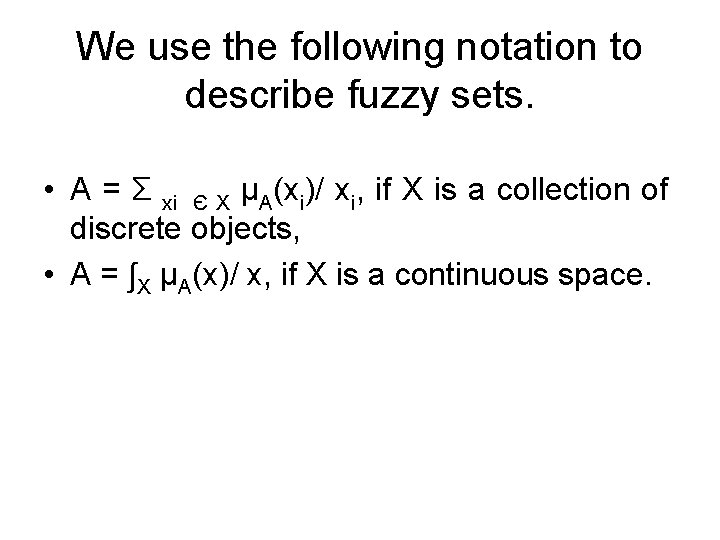
We use the following notation to describe fuzzy sets. • A = Σ xi Є X µA(xi)/ xi, if X is a collection of discrete objects, • A = ∫X µA(x)/ x, if X is a continuous space.
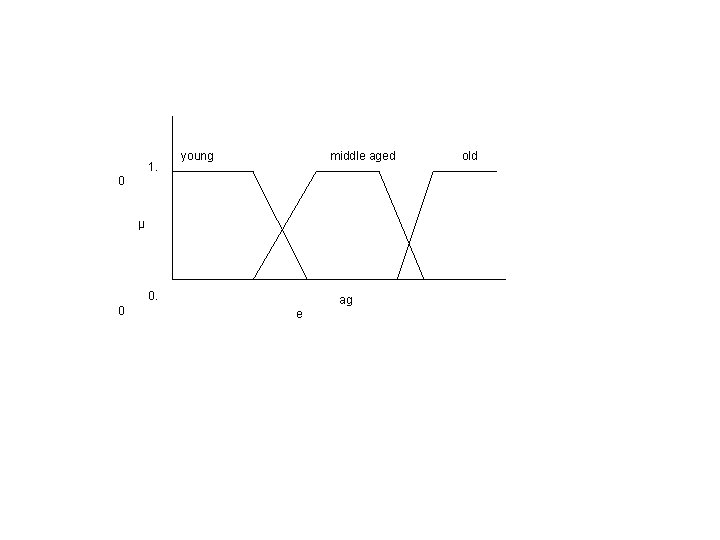
1. young middle aged 0 µ 0. 0 ag e old
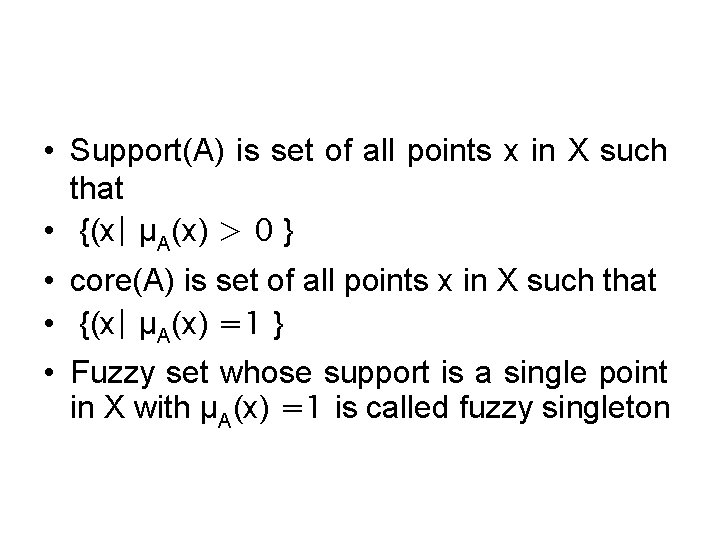
• Support(A) is set of all points x in X such that • {(x∣ µA(x) > 0 } • core(A) is set of all points x in X such that • {(x∣ µA(x) =1 } • Fuzzy set whose support is a single point in X with µA(x) =1 is called fuzzy singleton
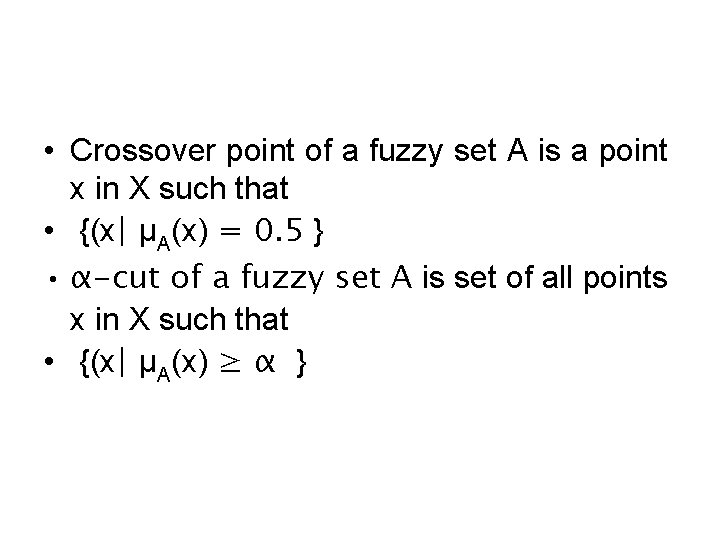
• Crossover point of a fuzzy set A is a point x in X such that • {(x∣ µA(x) = 0. 5 } • α-cut of a fuzzy set A is set of all points x in X such that • {(x∣ µA(x) ≥ α }
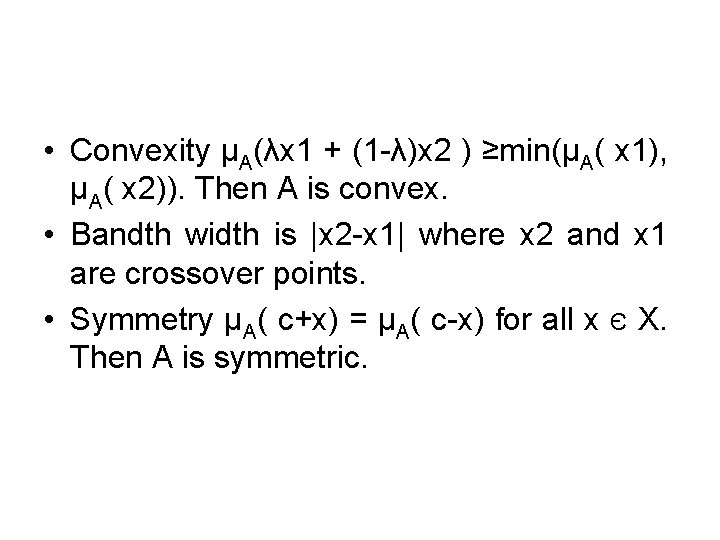
• Convexity µA(λx 1 + (1 -λ)x 2 ) ≥min(µA( x 1), µA( x 2)). Then A is convex. • Bandth width is |x 2 -x 1| where x 2 and x 1 are crossover points. • Symmetry µA( c+x) = µA( c-x) for all x Є X. Then A is symmetric.
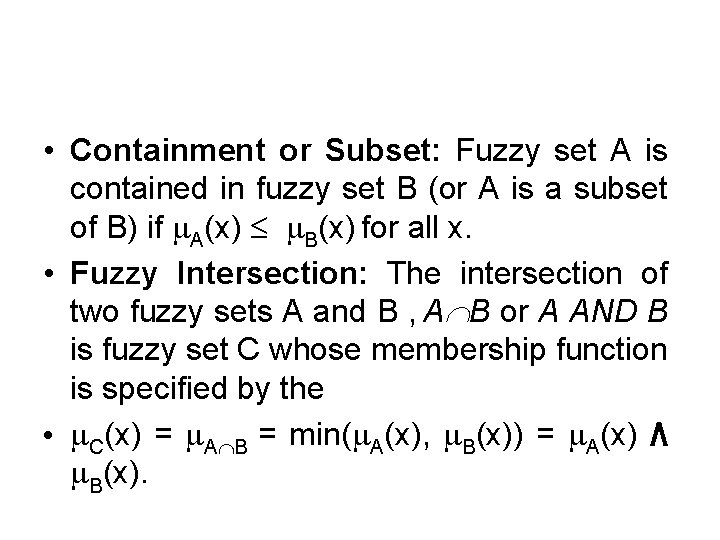
• Containment or Subset: Fuzzy set A is contained in fuzzy set B (or A is a subset of B) if A(x) B(x) for all x. • Fuzzy Intersection: The intersection of two fuzzy sets A and B , A B or A AND B is fuzzy set C whose membership function is specified by the • C(x) = A B = min( A(x), B(x)) = A(x) ٨ B(x).
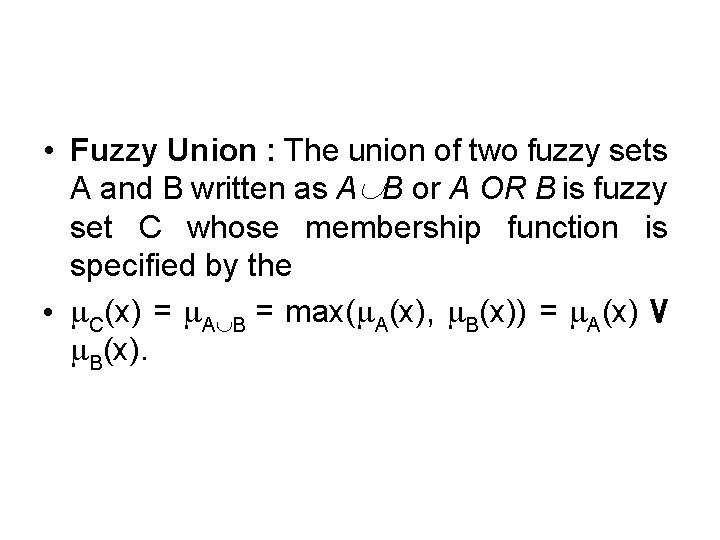
• Fuzzy Union : The union of two fuzzy sets A and B written as A B or A OR B is fuzzy set C whose membership function is specified by the • C(x) = A B = max( A(x), B(x)) = A(x) ٧ B(x).
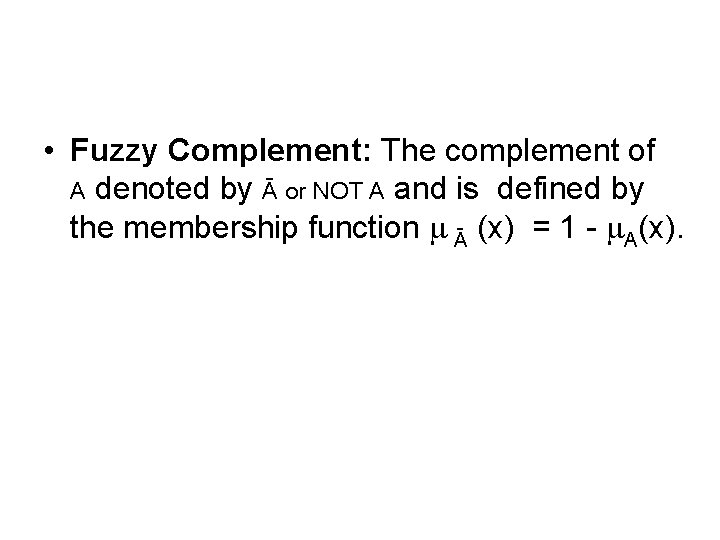
• Fuzzy Complement: The complement of A denoted by Ā or NOT A and is defined by the membership function Ā (x) = 1 - A(x).
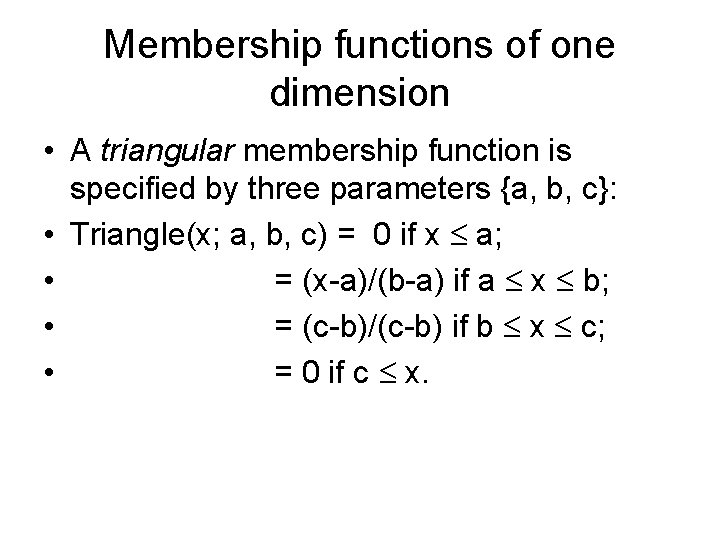
Membership functions of one dimension • A triangular membership function is specified by three parameters {a, b, c}: • Triangle(x; a, b, c) = 0 if x a; • = (x-a)/(b-a) if a x b; • = (c-b)/(c-b) if b x c; • = 0 if c x.
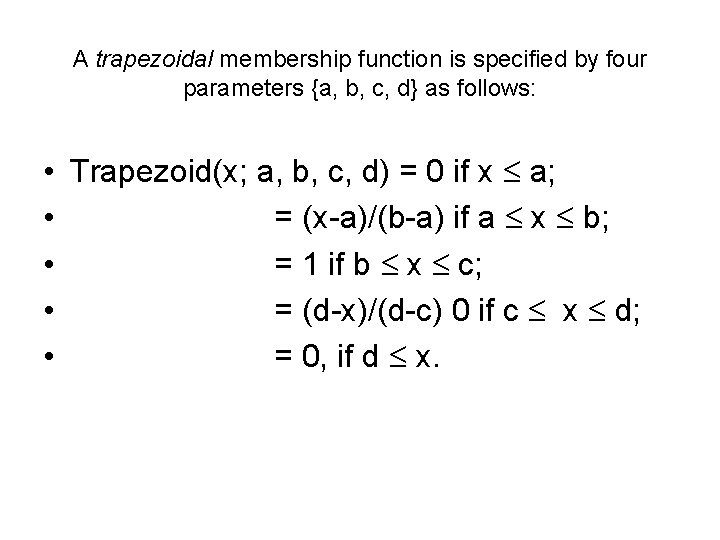
A trapezoidal membership function is specified by four parameters {a, b, c, d} as follows: • Trapezoid(x; a, b, c, d) = 0 if x a; • = (x-a)/(b-a) if a x b; • = 1 if b x c; • = (d-x)/(d-c) 0 if c x d; • = 0, if d x.
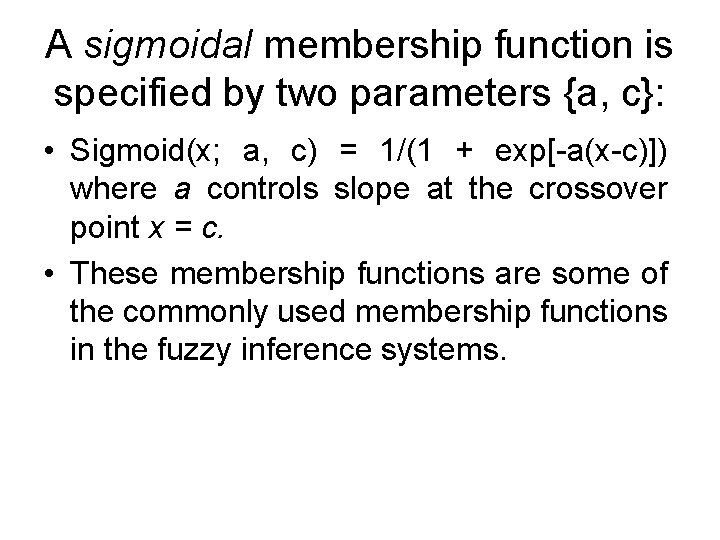
A sigmoidal membership function is specified by two parameters {a, c}: • Sigmoid(x; a, c) = 1/(1 + exp[-a(x-c)]) where a controls slope at the crossover point x = c. • These membership functions are some of the commonly used membership functions in the fuzzy inference systems.
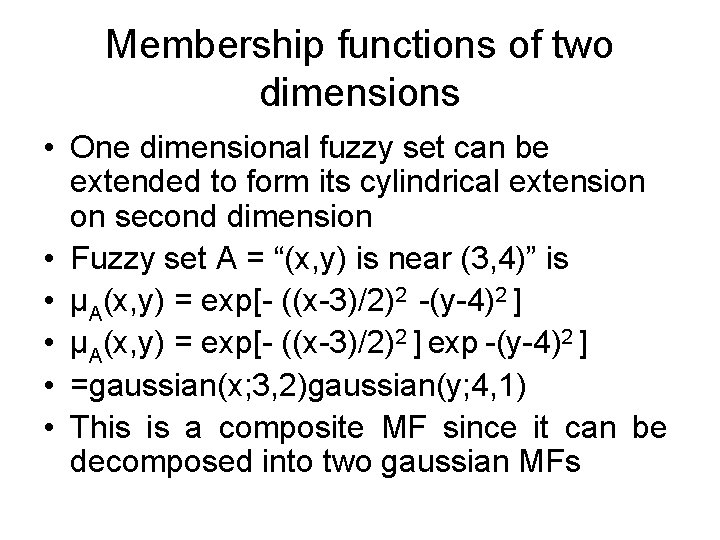
Membership functions of two dimensions • One dimensional fuzzy set can be extended to form its cylindrical extension on second dimension • Fuzzy set A = "(x, y) is near (3, 4)" is • µA(x, y) = exp[- ((x-3)/2)2 -(y-4)2 ] • µA(x, y) = exp[- ((x-3)/2)2 ] exp -(y-4)2 ] • =gaussian(x; 3, 2)gaussian(y; 4, 1) • This is a composite MF since it can be decomposed into two gaussian MFs
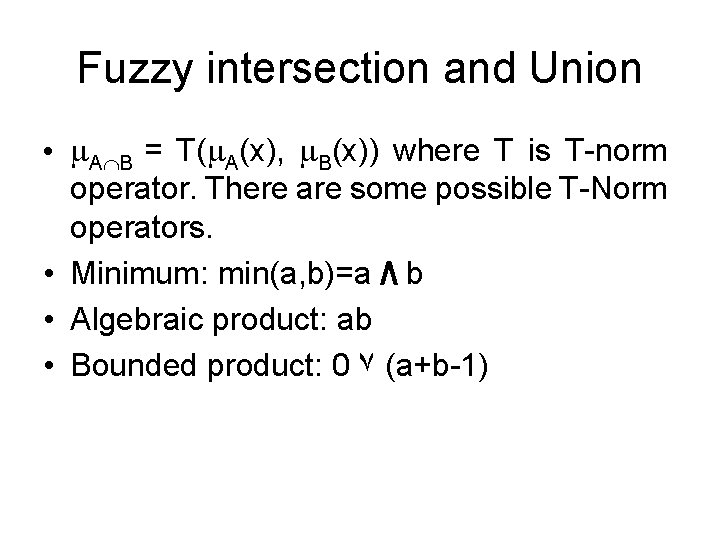
Fuzzy intersection and Union • A B = T( A(x), B(x)) where T is T-norm operator. There are some possible T-Norm operators. • Minimum: min(a, b)=a ٨ b • Algebraic product: ab • Bounded product: 0 ٧ (a+b-1)
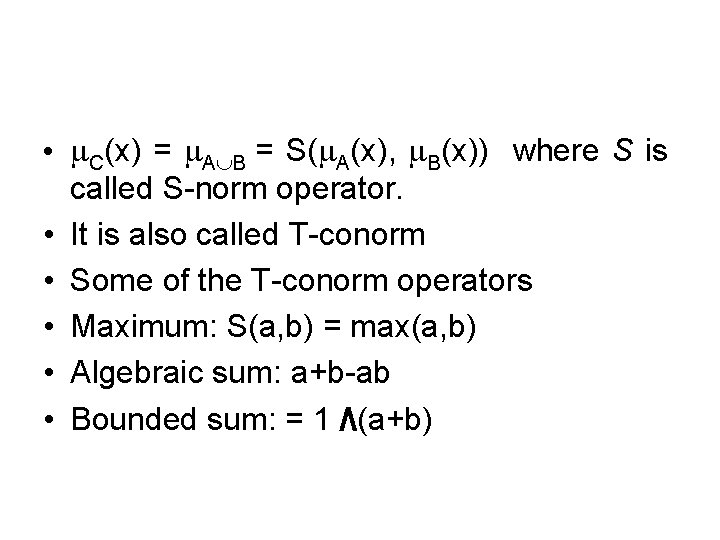
• C(x) = A B = S( A(x), B(x)) where S is called S-norm operator. • It is also called T-conorm • Some of the T-conorm operators • Maximum: S(a, b) = max(a, b) • Algebraic sum: a+b-ab • Bounded sum: = 1 ٨(a+b)
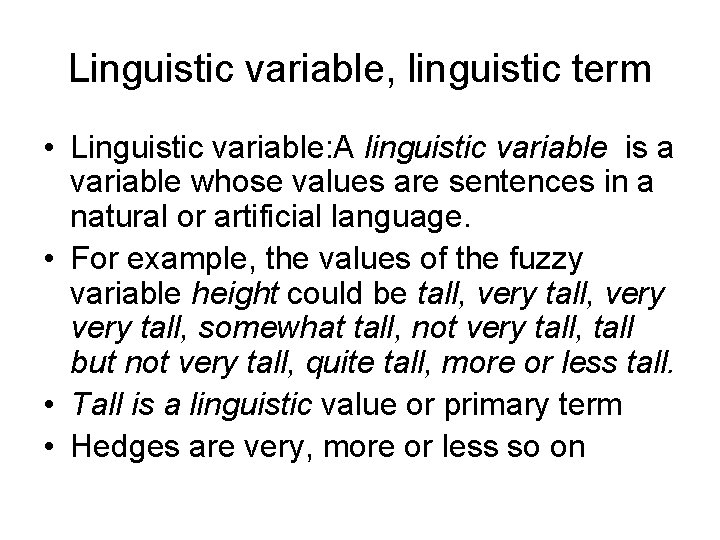
Linguistic variable, linguistic term • Linguistic variable: A linguistic variable is a variable whose values are sentences in a natural or artificial language. • For example, the values of the fuzzy variable height could be tall, very tall, somewhat tall, not very tall, tall but not very tall, quite tall, more or less tall. • Tall is a linguistic value or primary term • Hedges are very, more or less so on
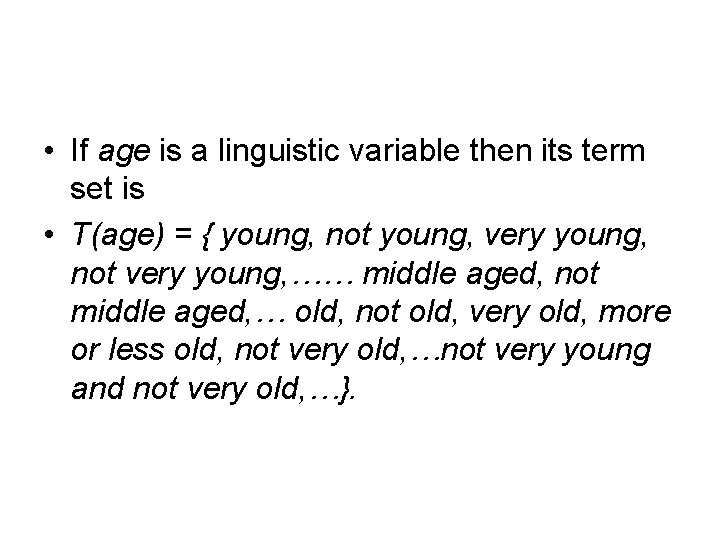
• If age is a linguistic variable then its term set is • T(age) = { young, not young, very young, not very young, …… middle aged, not middle aged, … old, not old, very old, more or less old, not very old, …not very young and not very old, …}.
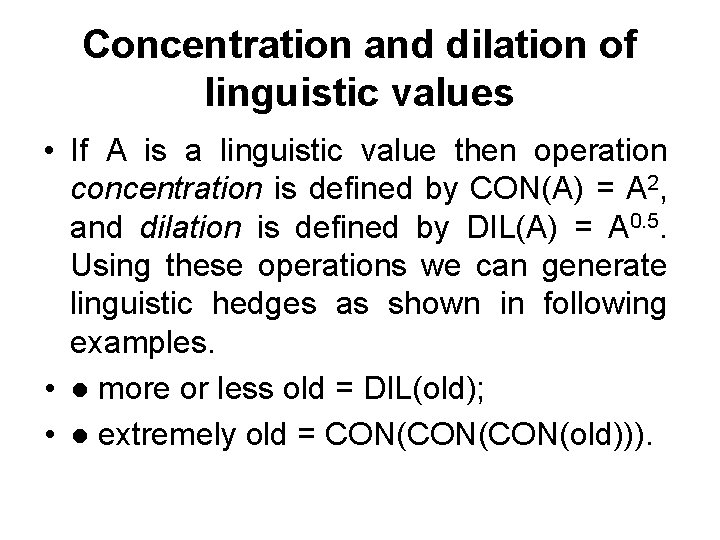
Concentration and dilation of linguistic values • If A is a linguistic value then operation concentration is defined by CON(A) = A 2, and dilation is defined by DIL(A) = A 0. 5. Using these operations we can generate linguistic hedges as shown in following examples. • ● more or less old = DIL(old); • ● extremely old = CON(CON(old))).
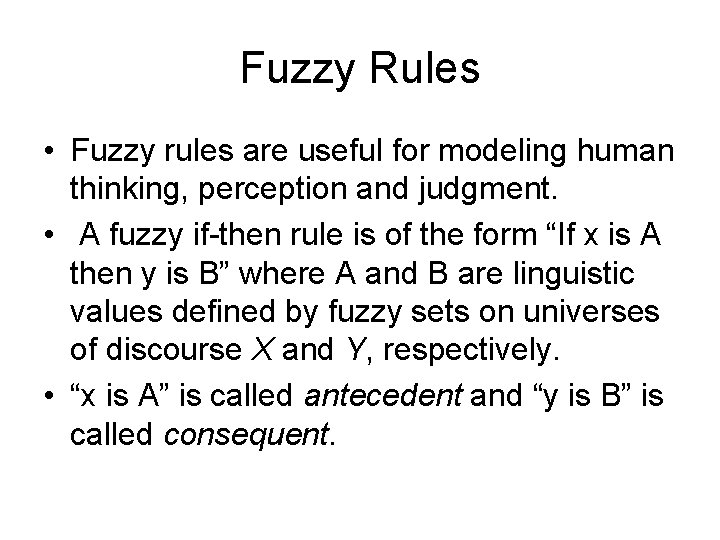
Fuzzy Rules • Fuzzy rules are useful for modeling human thinking, perception and judgment. • A fuzzy if-then rule is of the form "If x is A then y is B" where A and B are linguistic values defined by fuzzy sets on universes of discourse X and Y, respectively. • "x is A" is called antecedent and "y is B" is called consequent.
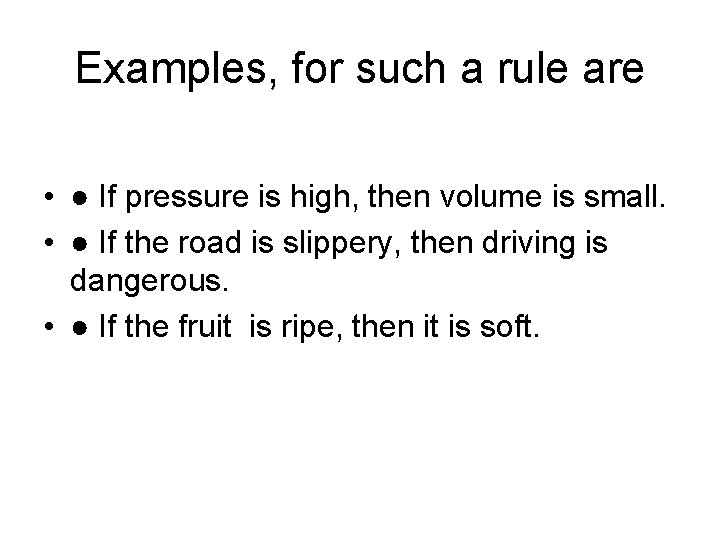
Examples, for such a rule are • ● If pressure is high, then volume is small. • ● If the road is slippery, then driving is dangerous. • ● If the fruit is ripe, then it is soft.
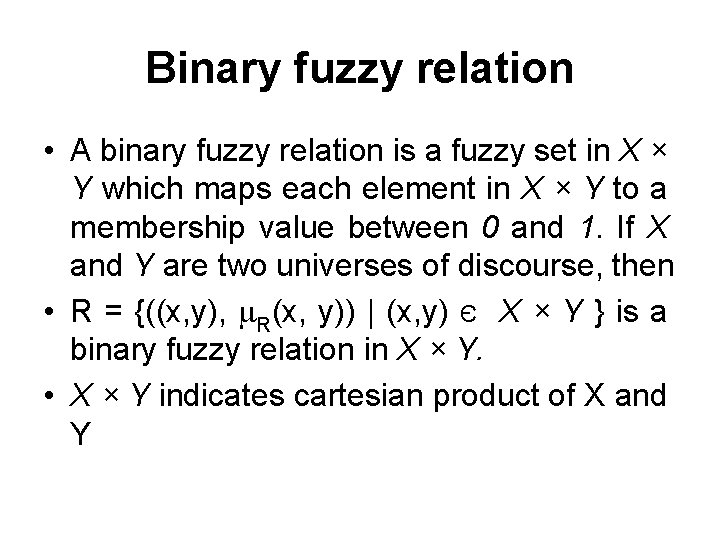
Binary fuzzy relation • A binary fuzzy relation is a fuzzy set in X × Y which maps each element in X × Y to a membership value between 0 and 1. If X and Y are two universes of discourse, then • R = {((x, y), R(x, y)) | (x, y) Є X × Y } is a binary fuzzy relation in X × Y. • X × Y indicates cartesian product of X and Y
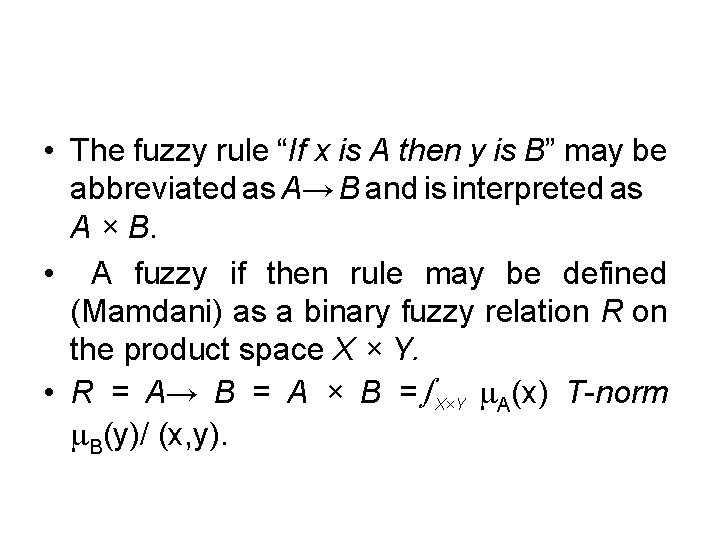
• The fuzzy rule "If x is A then y is B" may be abbreviated as A→ B and is interpreted as A × B. • A fuzzy if then rule may be defined (Mamdani) as a binary fuzzy relation R on the product space X × Y. • R = A→ B = A × B =∫X×Y A(x) T-norm B(y)/ (x, y).
References • Zadeh, L. (1965), "Fuzzy sets", Information and Control, 8: 338 -353 • Jang J. S. R. , (1997): ANFIS architecture. In: Neuro-fuzzy and Soft Computing (J. S. Jang, C. -T. Sun, E. Mizutani, Eds. ), Prentice Hall, New Jersey
Source: https://slidetodoc.com/fuzzy-logic-introduction-s-g-sanjeevi-fuzzy-set/
0 Response to "5 Fuzzy Sets on 1100 Continuous Universe"
Post a Comment